
Allgemeine Informationen rund um die Kurse von K. S. Pasupuleti
- Dozent/in: Karthik Sai Pasupuleti
State Space Models (SSMs) such as S4 and Mamba have emerged as the most prominent
efficient alternative to Transformers for large language models, because they process
sequences through genuine linear recurrence over time rather than through attention.
Spiking Neural Networks (SNNs) also compute over discrete timesteps, yet in almost
every existing "spiking LLM" those timesteps serve as a numeric-precision device rather
than as real time. This raises the central question of this work: can the mechanisms
responsible for the success of SSMs selective, input-dependent recurrence, principled
long-range memory, and parallelizable training be realized within the dynamics of a
spiking neuron itself, so that a spiking language or vision-language model computes over
time rather than merely accounting for it?
- Dozent/in: Karthik Sai Pasupuleti
Weitere Kurse
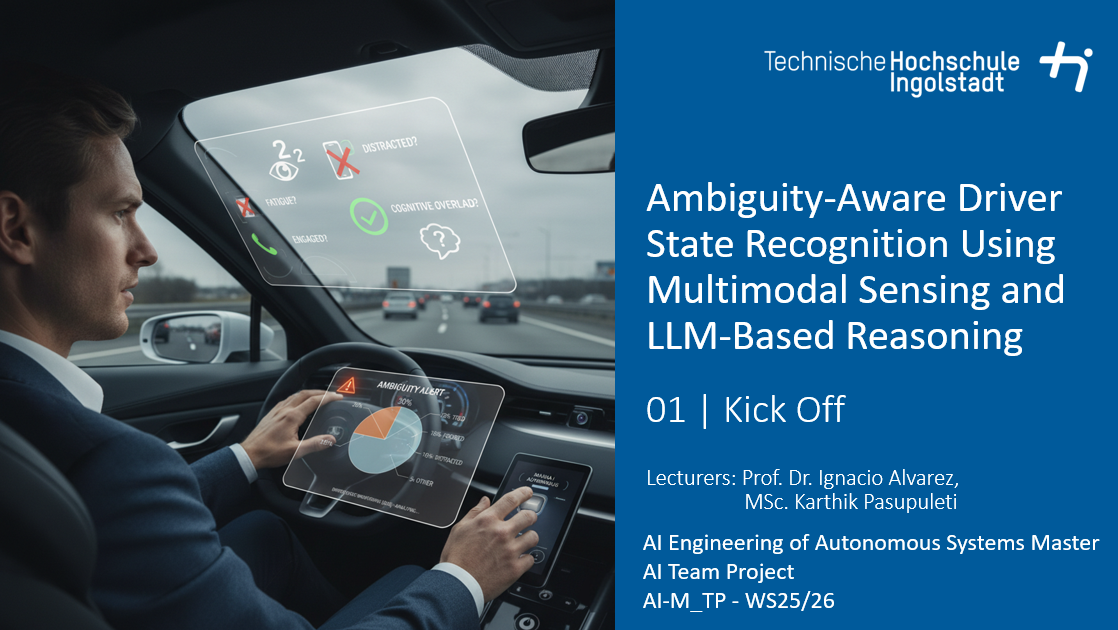
Driver states such as drowsiness, cognitive overload, or inattention are critical to road safety, yet their recognition is often complicated by ambiguous or conflicting signals. Human behavior and states are inherently complex and uncertain, which is overlooked by traditional driver monitoring systems as they typically output a single predicted state. Recent advancements in large language models (LLMs) offer a unique opportunity to interpret such ambiguity by common sense reasoning over multimodal inputs, and provide multiple context-aware interpretations and interventions.
In this project, students will design and prototype an in-vehicle assistant that can detect and assess a chosen driver state (drowsiness, attention, workload) through ambiguity-awareness. The system will utilize multimodal inputs like facial expressions, posture, eye tracking, and driving behavior, along with contextual cues (time of day, traffic, driving duration) to resolve data conflicts and ambiguity via LLM reasoning. Based on its interpretation, the assistant will present its top inferred states combined with confidence levels, and appropriate next steps such as initiating an intervention or requesting further input. The system will also incorporate user feedback to refine its reasoning process and improve ambiguity resolutions. Students will evaluate system’s usability, perceived effectiveness in conveying ambiguous and complex states, exploring how LLM-driven reasoning can support more transparent and explainable human-vehicle interaction.
- Dozent/in: Ignacio Alvarez
- Dozent/in: Karthik Sai Pasupuleti
- Dozent/in: Dominik Mattern
- Dozent/in: Karthik Sai Pasupuleti
- Dozent/in: Katherine Roegner
- Dozent/in: Klaus-Peter Tamm
- Mitdozierende/r: Abhishek Patel