
Allgemeine Informationen rund um die Kurse von V. Chandrayan
- Dozent/in: Vanchha Chandrayan
In this course, a typical UX design task is tackled in small groups at the beginning of the semester, based on a practical example. The aim is to raise students' awareness of different problem areas and simultaneously promote social interaction within the study group.
- Team building activities
- Exemplary implementation of the UX process from analysis and conception to detailing and design.
- Stakeholder analysis, persona development, ideation, sketching and wireframing
- Development of the design and preparation of the results for implementation
- Project presentation to the team
- Documentation of the entire process as a PDF file and accompanying video.
- Dozent/in: Ignacio Alvarez
- Dozent/in: Vanchha Chandrayan
Weitere Kurse
- Dozent/in: Vanchha Chandrayan
- Dozent/in: Diah Ayu Irawati
- Dozent/in: Katharina Kleine
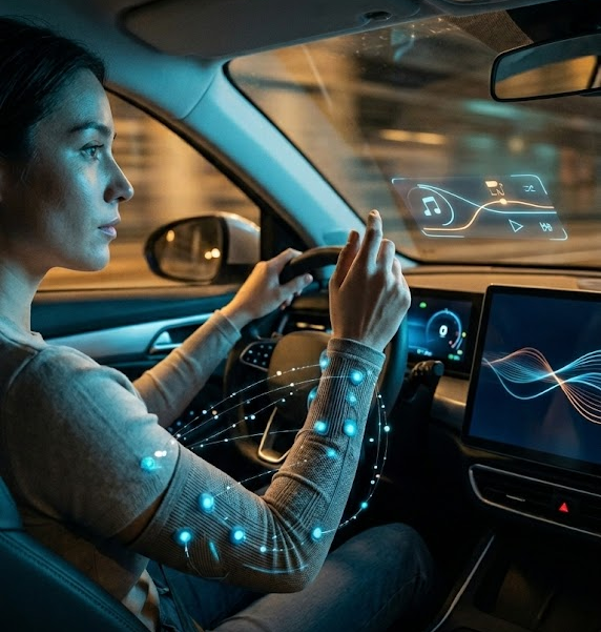
As vehicles become increasingly intelligent and assistive, the challenge of designing intuitive, safe, and low-distraction interaction methods becomes more critical. Voice, visual, and touch interfaces, although common and widely used, can be intrusive or unreliable in certain situations. Electromyography (EMG) sensors offer a promising alternative by detecting subtle muscle activations that reflect a driver's intent or emotional state. These muscle-based gestures can enable silent, quick, and low-distraction communication between driver and vehicle systems, supporting a more natural, intuitive, and adaptive human-vehicle interaction.
In this project, students will explore how EMG-based gestures can be leveraged to improve in-vehicle interaction and feedback. They will design and investigate how such gestures can support communication and feedback integration with an LLM-based in-cabin assistant. This includes how drivers might express intent, preferences, or reactions to system assistance through adaptive gestures; and how LLMs can interpret or adapt to such inputs to enable natural and context-aware interactions. Students will analyze how this modality for interaction affects overall usability, trust, and satisfaction, and examine how it complements/interferes with other modalities like voice or touch.
- Dozent/in: Ignacio Alvarez
- Mitdozierende/r: Vanchha Chandrayan
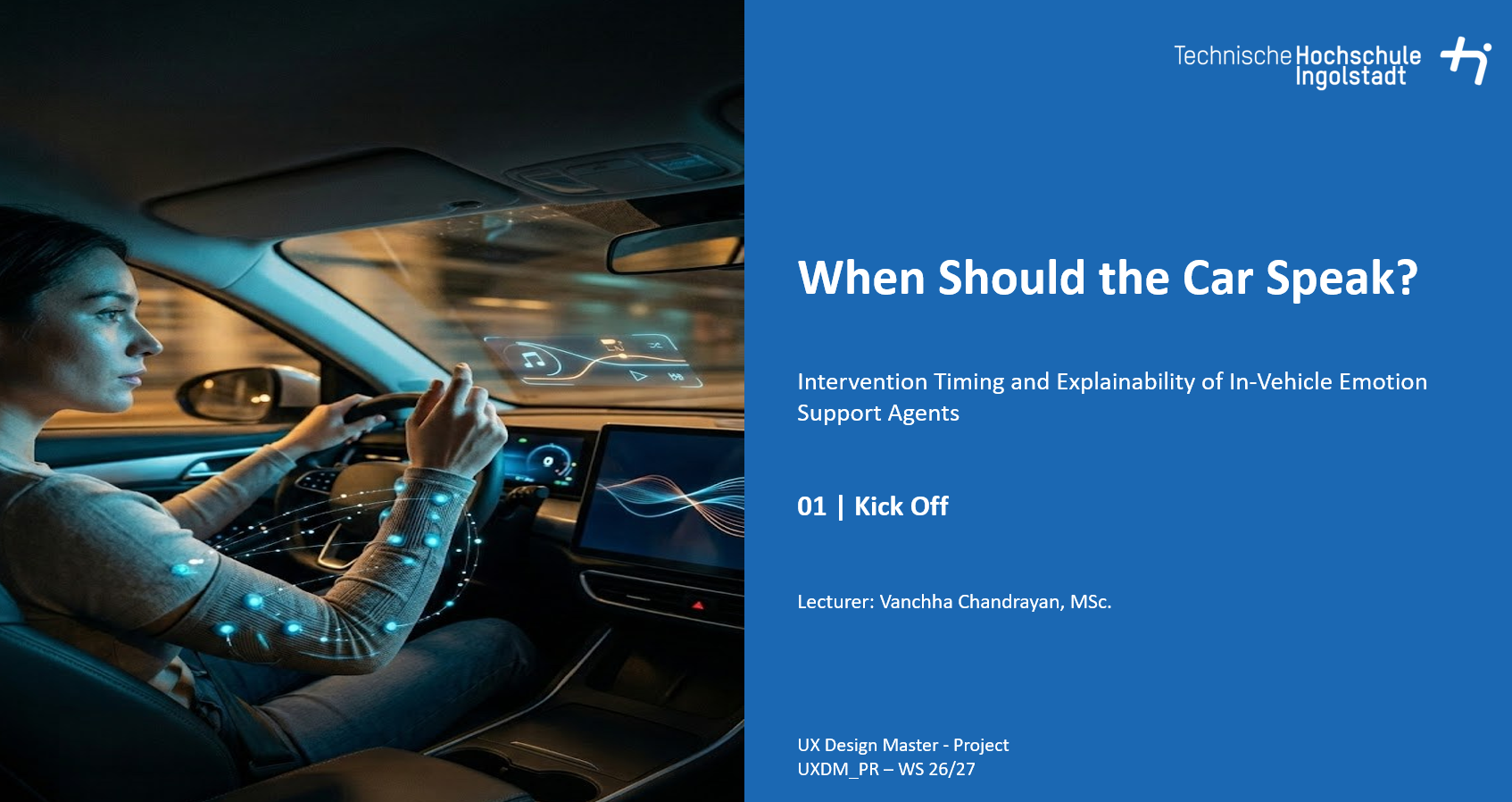
When should the car speak? Intervention Timing and Explainability of in-vehicle emotion support agents
Lecturer: Vanchha Chandrayan
- Dozent/in: Ignacio Alvarez
- Mitdozierende/r: Vanchha Chandrayan
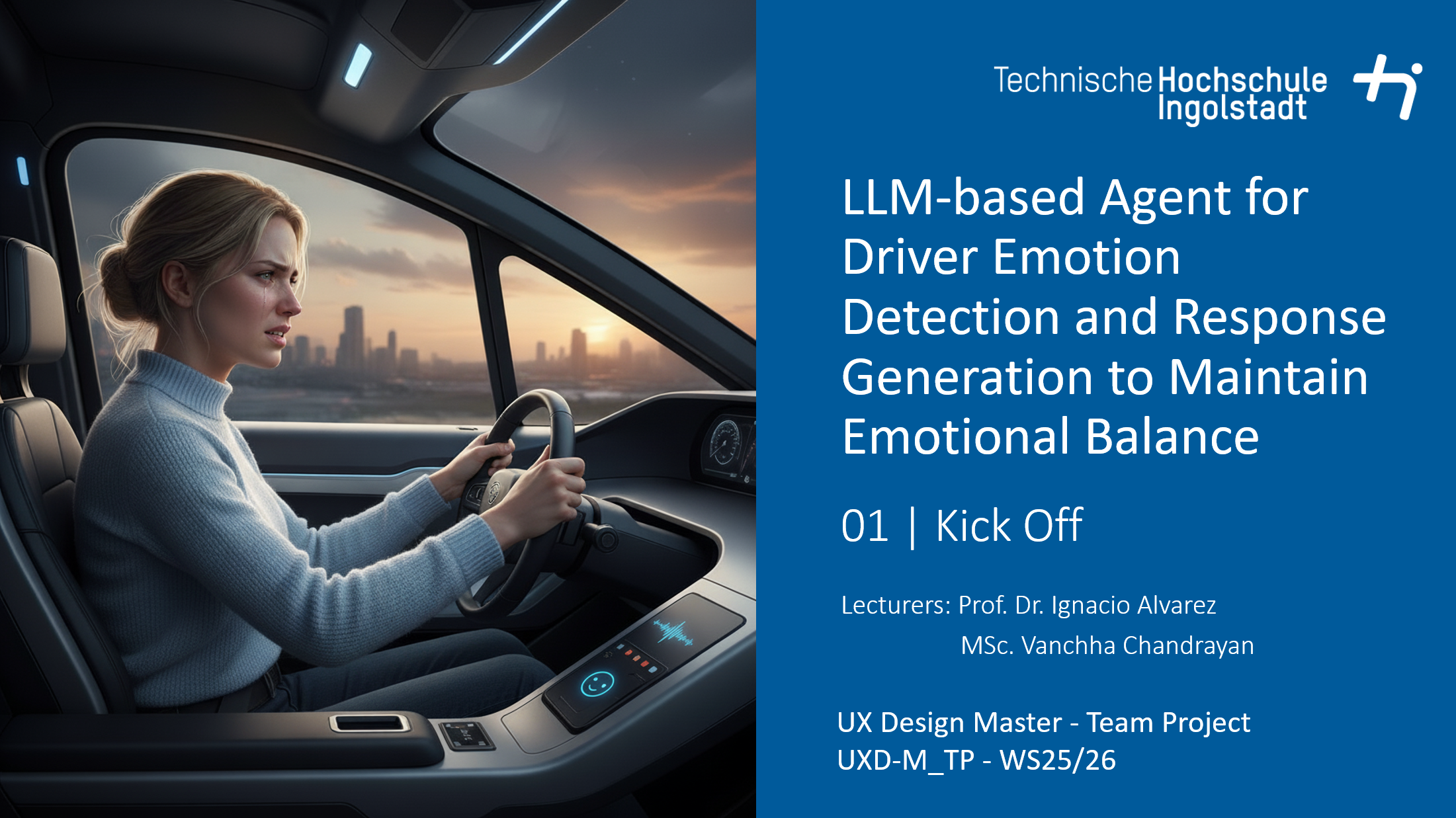
Emotions like anger, frustration, or anxiety can compromise driving performance by impairing situational awareness, reaction times, and decision making. Recent advancements in large language models (LLMs) have shown reasoning capabilities in detecting complex emotions using multiple modalities. By integrating multimodal sensor data and contextual driving information, LLMs can also be leveraged to detect vehicle occupant emotions and trigger actions to mitigate their impact on driving performance.
In this project, the students will design and prototype an automotive in-cabin assistant to detect driver emotions and respond through context-aware recommendations to support safer driving. The system will utilize multimodal inputs (voice, facial features, heart rate, driving behavior), contextual signal like traffic conditions, driving duration, weather conditions. Based on this information, the assistant will generate appropriate responses such as offering calming suggestions, initiating empathetic conversations. Students will evaluate system’s usability, perceived appropriateness and supportiveness of the system, and investigate how LLM-driven emotion recognition and context-aware responses can enhance human-vehicle interaction.
- Dozent/in: Ignacio Alvarez
- Dozent/in: Vanchha Chandrayan
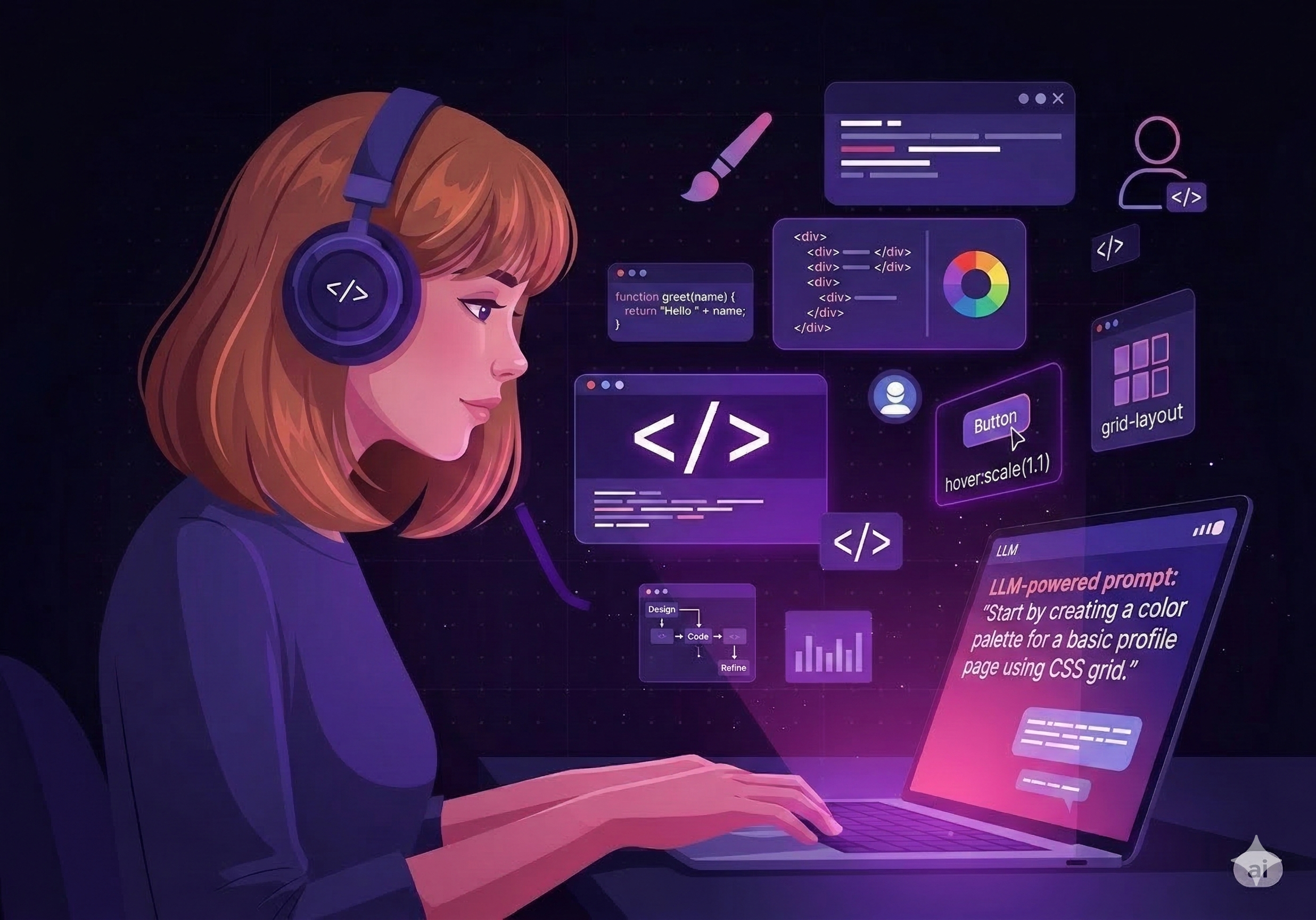
Moodle for UXD Bachelor Elective - Introduction to Vibe Coding for User Experience Designers:
The course provides a practical introduction to the integration of generative AI and "vibe coding" into UX workflows.
Students will:
- Explore foundational concepts of Generative AI, focusing on LLMs.
- Learn techniques of prompt engineering to effectively direct AI tools.
- Apply AI-driven methods to enhance UX research processes, from data collection to synthesis and prototyping.
- Utilize AI-assisted development platforms, such as ChatGPT, Replit or Cursor, to prototype interactive user interfaces, tools and applications.
- Undertake a comprehensive final group project, culminating in designing, building, and presenting a software tool that addresses a defined UX issue.
- Dozent/in: Ignacio Alvarez
- Mitdozierende/r: Vanchha Chandrayan