
Allgemeine Informationen rund um die Kurse von S.-A. Bibi
- Dozent/in: Sven-Anwar Bibi
Background
AI agents — powered by large language models (LLMs) — are evolving from support tools into digital collaborators. In areas like wellbeing, leadership, and personal development, these systems now perform complex tasks such as prompting reflection or supporting decision-making.
Designing such agents calls for a shift in UX practice. Instead of static interfaces, designers must create interactive, context-sensitive, and ethically aligned systems. Trust, transparency, emotional safety, and memory handling are central to such experiences. The course builds on the principles of ISO 9241-210, the EU AI Act (2024), GDPR, and ethical design frameworks from IEEE and EU HLEG.
Project Description
At the heart of this project is a design challenge: how can we, as UX designers, create digital agents that people not only use — but trust, understand, and want to interact with?
Students will conceptualize and prototype a context-aware, AI-powered companion designed for reflective, emotionally sensitive use cases (e.g., wellbeing, leadership, personal development). Unlike productivity bots or utility-based assistants, this agent supports users in navigating complex thoughts, feelings, or decisions — without offering shallow answers, fixed advice, or diagnostic responses.
This calls for highly intentional UX design. The interface must be more than usable — it must be ethically grounded, emotionally attuned, and contextually intelligent. Students must design:
-
The agent’s tone of voice
-
How it builds and references memory
-
How it behaves under uncertainty or failure
-
How trust and boundaries are expressed in both content and interaction patterns
Students will explore the design of agentic behavior: how the system signals its capabilities, limitations, and intentions. They must actively shape the user’s mental model of the AI through UX decisions — including how information is framed, how prompts are structured, and how expectations are managed over time.
Throughout the course, students will apply human-centered design principles (ISO 9241-210), design for legal and ethical alignment (GDPR, EU AI Act), and reflect on what it means to create user experiences that are not just effective — but responsible, meaningful, and safe.
This project is not about building AI systems. It is about designing the experience of being in a relationship with one.
Project Goals
- Analyze human–AI interaction in emotionally sensitive domains
- Define user needs, risks, and trust boundaries
- Design agent behaviors, tone, and escalation logic
- Create prototypes for conversational or multimodal UX
- Evaluate usability and emotional trust through small-scale tests
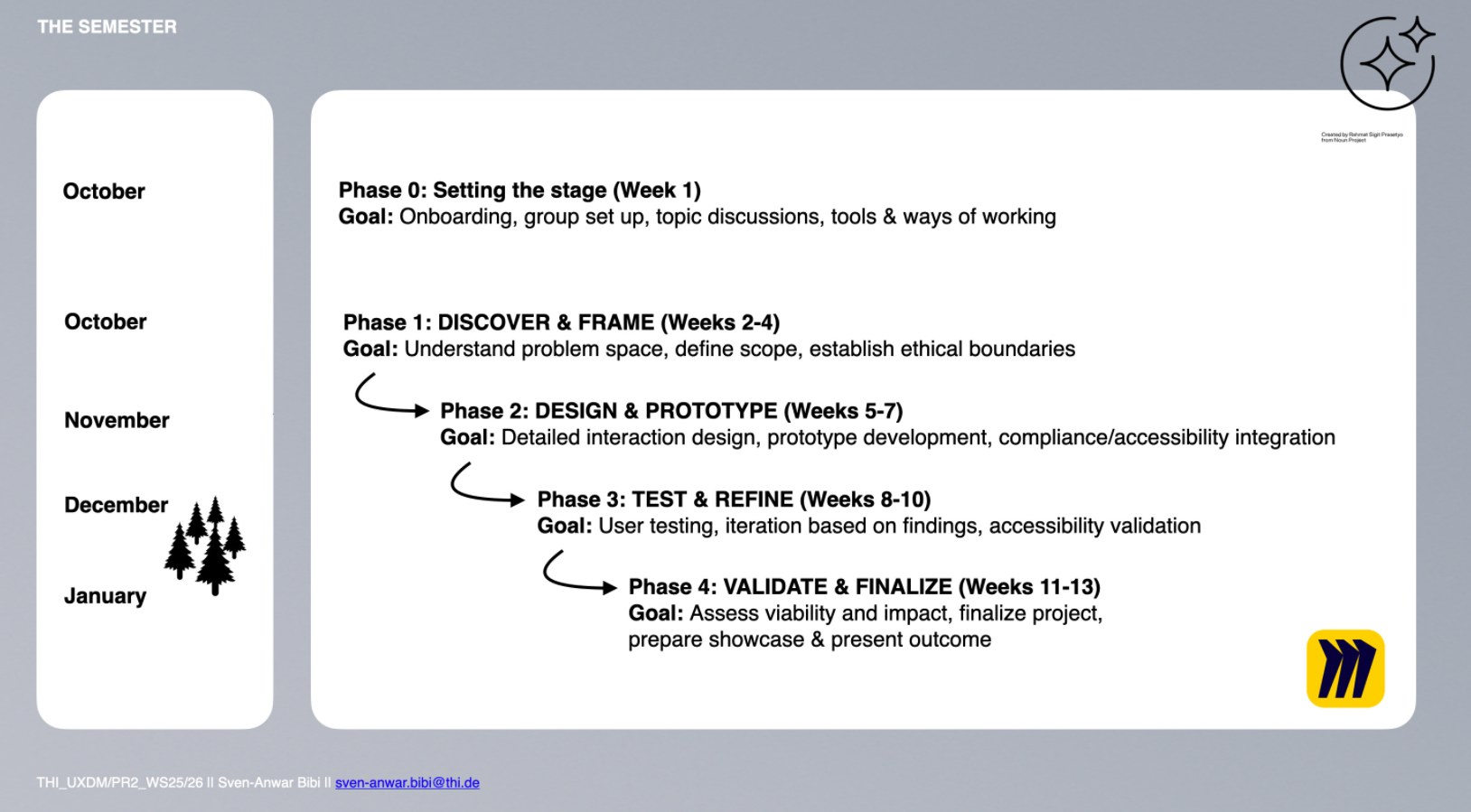
Activities
- Research: Investigate existing AI agents (e.g., Replika, Pi, Manus)
- User study: Conduct qualitative research (interviews, diaries, probes)
- Concept development: Define role boundaries, memory strategies, trust-building elements
- Prototype: Build and test agent interaction using no-code platforms
- Testing: Run “friends-and-family” evaluations (tone, memory handling, failure modes)
- Reflection & documentation: Prepare a design log, system map, and final project report
- Presentation: Final showcase to peers and invited reviewers
Important Notes
- Suggested topics will be provided at kickoff
- Project goals and ethical constraints must be defined early
- The course includes alternating online/offline formats, coaching, and peer feedback
- Students will document AI tool usage in an "AI Design Log"
- Dozent/in: Sven-Anwar Bibi
- Dozent/in: Sven-Anwar Bibi